
Before you build a lead list, build clarity. The rest follows.
Why Lead Generation Is Not a Data Problem
Most businesses approach lead generation the same way:
1️⃣ Find a tool
2️⃣ Scrape a database
3️⃣ Build a large list
But the real question is rarely asked:
“What exactly are we trying to achieve—and what data will actually help us get there?”
Whether you’re exploring a new market, validating a potential partner, or building a sales pipeline—data is just the starting point. Not the strategy.
What Global Public Data Can (and Cannot) Do
Across countries, governments provide varying levels of access to company and market data. Some systems are highly structured. Others are fragmented. Many sit somewhere in between.
Highly Structured & Accessible Systems
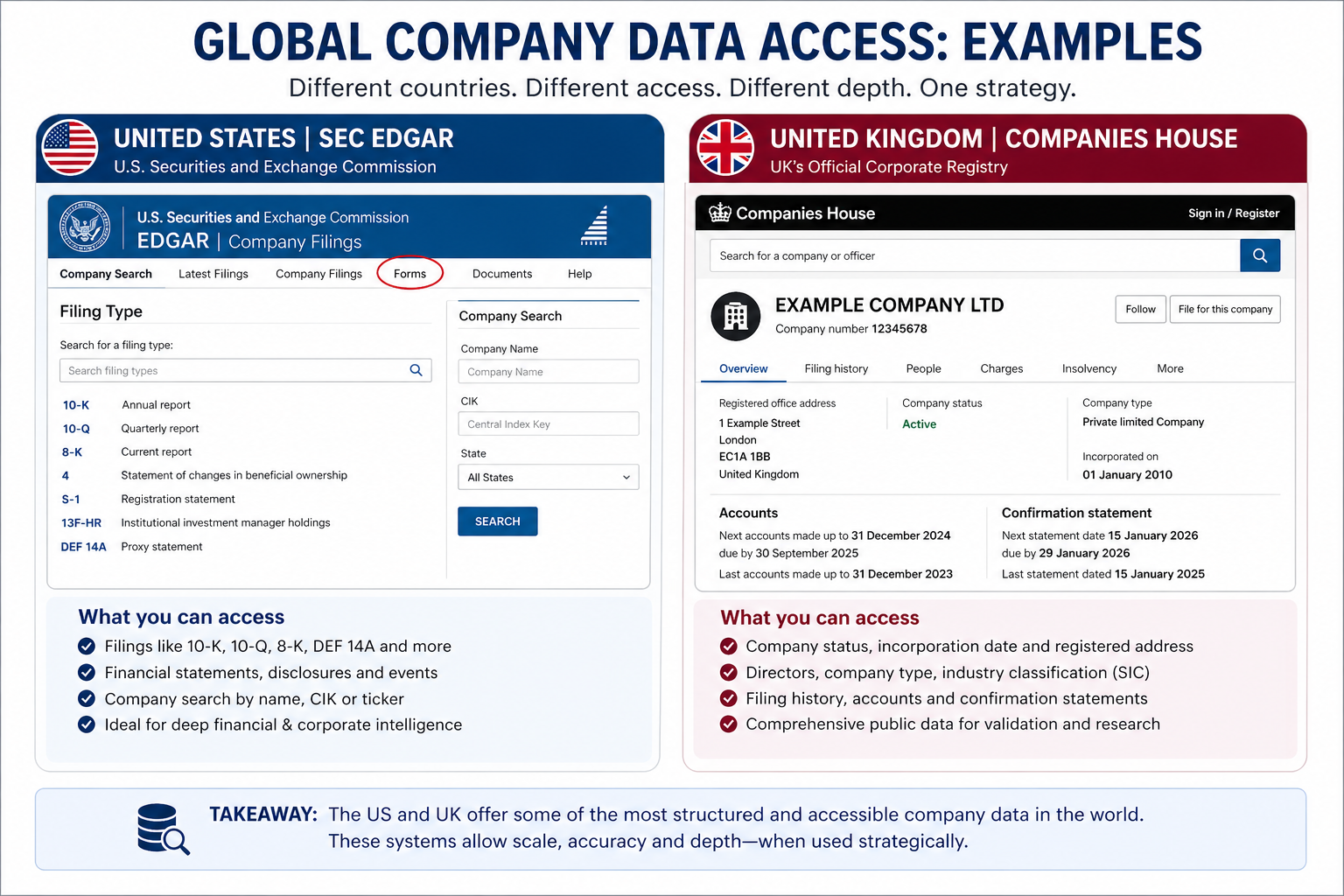
In countries like the United States and the United Kingdom, public data systems are highly structured:
🇺🇸 SEC EDGAR provides access to detailed filings like 10-K, 8-K, and financial disclosures
🇬🇧 Companies House offers company status, incorporation details, filings, and financial summaries
These systems allow businesses to:
✅ Validate companies at scale
✅ Analyze industries
✅ Build structured datasets
👉 But even here, data still needs interpretation.
Partially Accessible Systems (Strong for First-Pass Research)
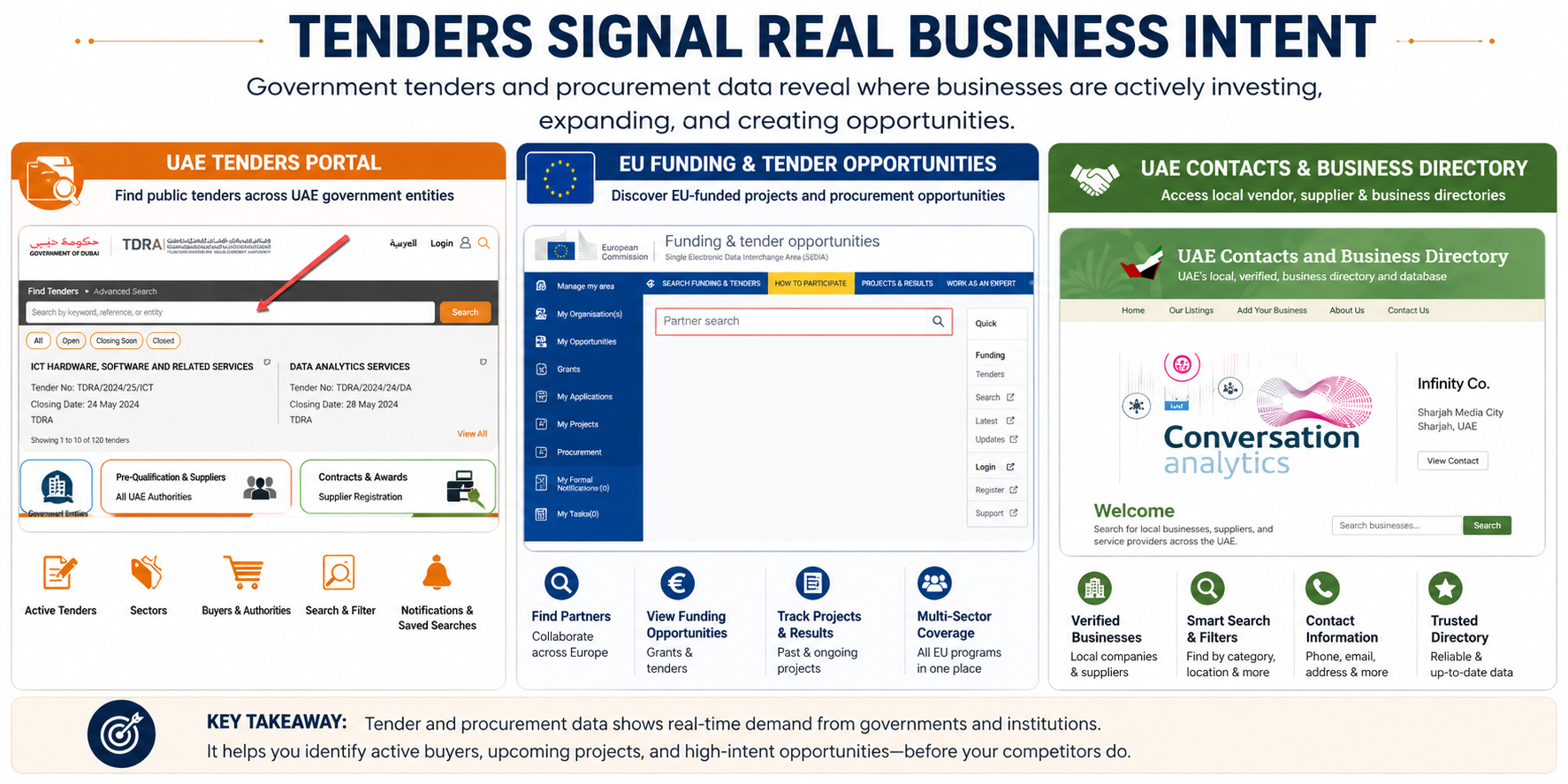
In regions like Singapore, the EU, and the UAE:
🇸🇬 ACRA provides basic company validation
🇪🇺 European databases offer tender data, procurement notices, and sanctions lists
🇦🇪 UAE provides directory-based and free-zone listings
👉 These are extremely useful for:
• Market entry validation
• Identifying active sectors
• Discovering companies participating in tenders
But: Data is often incomplete and requires combining multiple sources.
Restricted but Valuable Systems (India & France)
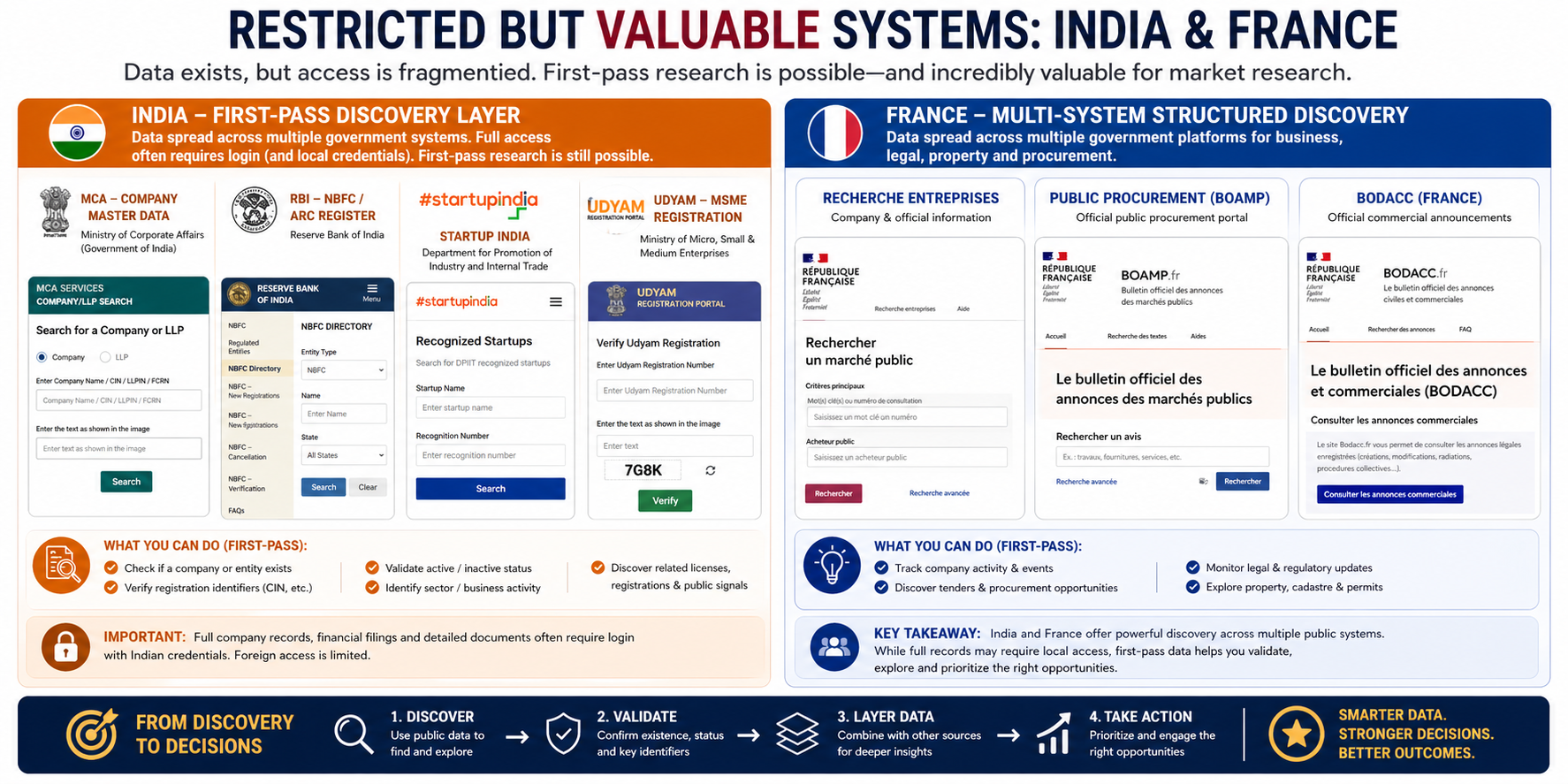
In countries like India and France, data exists—but with access limitations.
🇮🇳 India
• Data spread across systems like the Ministry of Corporate Affairs, RBI, Startup India, and others
• Full access often requires login (and local credentials)
• First-pass validation is still possible: company status, registration identifiers, sector classification
🇫🇷 France
• Data spread across multiple systems: BODACC (business events), Recherche Entreprises, property, legal, and procurement datasets
• Tender systems like BOAMP and TED
• Strong for: company activity tracking, tender discovery, regulatory monitoring
📌 Key takeaway: “These systems are powerful for discovery—but not designed as one unified, ready-to-use database.”
The Missing Piece — Tenders as a High-Intent Signal
Many businesses overlook one of the most valuable data points: Government tenders and procurement data.
Tenders tell you:
📊 Which companies are actively buying or expanding
💰 Which sectors are receiving investment
📍 Where budgets are being allocated
In regions like the EU and France, procurement databases like TED and BOAMP provide live demand signals.
👉 Unlike static company lists: Tenders represent real, time-bound business intent.
What Most Businesses Get Wrong
The most common mistake:
“If data is available, let’s scrape everything.”
This leads to:
❌ Large but irrelevant lists
❌ No prioritization
❌ Poor conversion
The Right Way to Think About Lead Generation
Start With Business Objectives
Before any data is pulled, define:
• Are you entering a new market?
• Looking for clients?
• Exploring partnerships?
• Tracking competitors?
👉 Your objective determines your data.
Use Public Data for Validation — Not Volume
Public datasets help answer:
✅ Does this company exist?
✅ Is it active?
✅ Which geography does it operate in?
✅ Has it participated in tenders?
👉 That’s validation—not targeting.
Build Intelligence Layer by Layer
A strong list is built by combining:
🏛️ Government data → validation
👤 LinkedIn → decision-makers
📰 News & hiring signals → intent
📋 Tender data → demand
Why This Needs to Be Consultative
“Lead generation is not a scraping project. It is a consulting project.”
Because someone needs to:
✔️ Understand your business objective
✔️ Identify which countries and sources matter
✔️ Work within access limitations
✔️ Combine fragmented datasets
✔️ Filter signal from noise
The Reality of Cross-Border Data
When working globally:
🟢 Some countries are open (UK, US)
🟡 Some are partially accessible (Singapore, EU, UAE)
🔴 Some require local access (India, France)
👉 In many cases: Local access, compliance, and context determine how deep you can go.
Final Thought
“In global lead generation, the advantage is not who can access more data. It’s who knows how to use the right data, in the right way, for the right objective.”
Before you build a list, build clarity.
The rest follows.
📚 Sources & References
SEC EDGAR • UK Companies House • MCA India • ACRA Singapore • BODACC France • EU Funding & Tenders • UAE National Economic Register
👉 Need Help Building a Smarter Lead Generation Strategy?
Let’s define your objectives first — then find the right data sources to match.
📩 Contact us: contact@anautomate.com