AI for small business is transforming how founders build, operate, and grow across the world. We analysed 620 real user voices across 50+ countries. What we found isn’t hype. It’s a shift in how small businesses operate, compete — and survive.
Two people. Same AI. Completely different outcomes.
“In previous companies I needed a team of 10–15 people… now we’re doing it with 2 people, moving 10x faster.”
— Entrepreneur, Colombia
“I had a moment when I thought I couldn’t write a single line of code without AI…”
— Software engineer, Netherlands
One is building faster than ever. The other is losing confidence in their own ability.
At first glance, this feels contradictory. But when you step back, something more interesting appears:
👉 AI is not creating one outcome. It is amplifying where you already stand.
If you have clarity → AI accelerates you
If you have confusion → AI amplifies that too
Earlier this year, Anthropic released one of the most detailed qualitative datasets on AI usage — conversations with 81,000 people globally. From that, 620 real quotes were published.
👉 Read Anthropic’s global study
We analysed every single one of them — across geography, occupation, sentiment, and use case.
What emerged is not a simple story of hope or fear.
👉 It’s a layered reality — and small business owners are right at the center of it.
AI Is Not One Story — It’s Three Different Realities
Most AI conversations online assume a single narrative. But globally, that’s not what’s happening.
In Developed Markets → AI Is Creating Anxiety
In North America and Western Europe, AI is not just a tool — it’s an identity disruptor.
People are questioning:
• Their relevance
• Their skills
• Their long-term role
There is a visible shift from:
👉 “How can I use AI?”
to
👉 “Will I still matter if AI does this better?”
This shows up especially in writers, developers, and knowledge workers — where the fear is not job loss immediately, but gradual erosion of expertise.
In Emerging Markets → AI Is Unlocking Opportunity
Now contrast that with South Asia, Africa, Southeast Asia, Latin America.
The tone changes completely.
Here, AI is not replacing something. 👉 It is enabling something for the first time.
Examples across the dataset:
• First-time entrepreneurs building apps
• Non-coders launching businesses
• Individuals bypassing expensive services
For many users: 👉 AI is not a threat. 👉 It is a starting point.
For Small Businesses → AI Is Leverage
This is where your world sits.
Small business owners are not thinking in abstract terms. They are asking:
• Can I save time?
• Can I reduce costs?
• Can I do more without hiring?
And increasingly: 👉 AI is answering “yes” to all three.
But — and this is important — 👉 The benefit is not automatic. 👉 It depends on how you use it.
The One-Person Business Is Now Real
This is the most powerful shift across all 620 voices.
And it cuts across geography, skill levels, and industries.
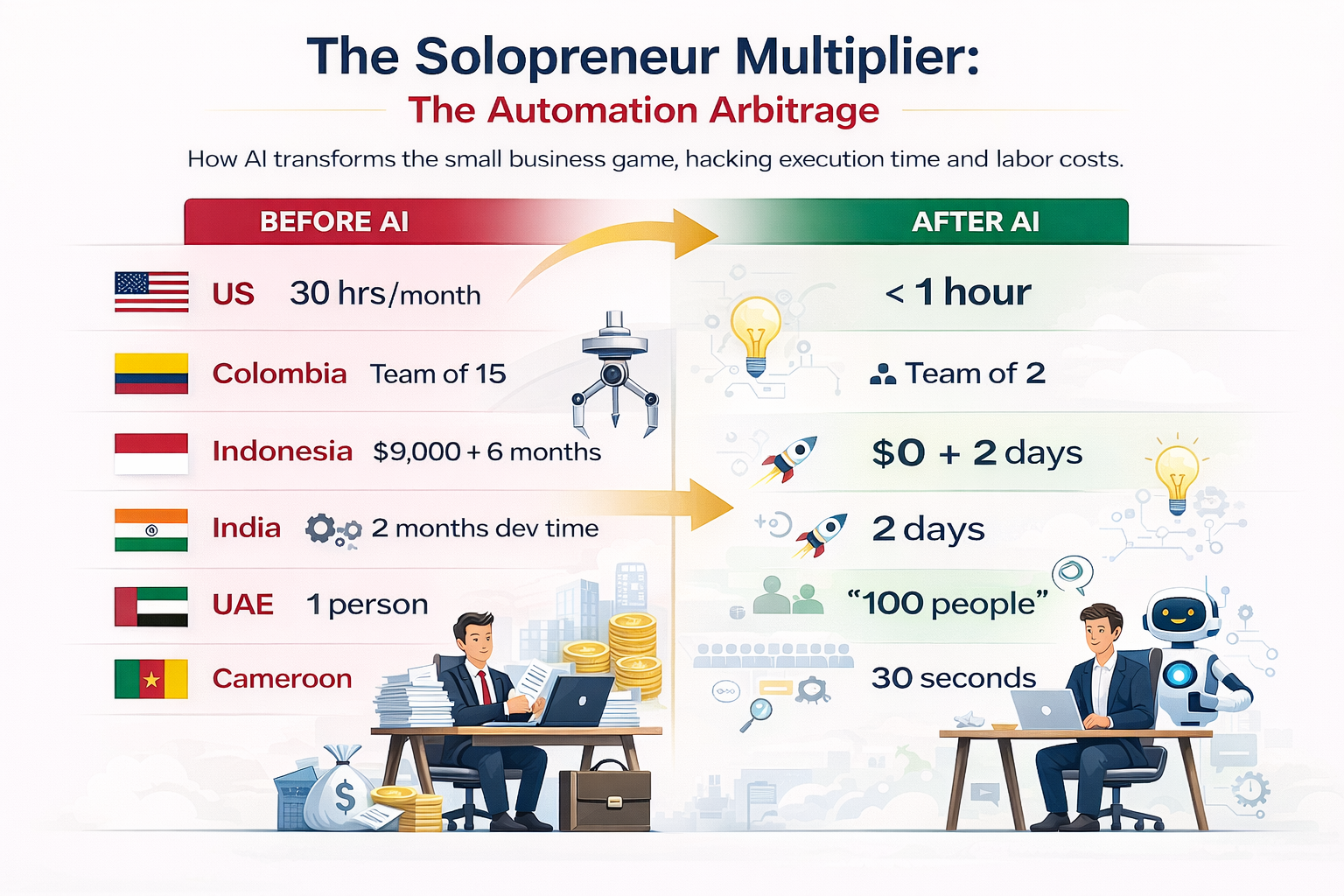
What Used to Take Teams… Now Takes One Person
We are seeing consistent patterns:
• Accounting work reduced from 30 hours to 1 hour
• Software built in days instead of months
• Marketing, content, research handled by a single person
• Entire workflows replaced by automation + AI
🇮🇩 A founder in Indonesia built a full system in 2 days.
🇮🇳 A small-town business owner in India built an app in 48 hours.
🇨🇴 A founder in Colombia replaced a 15-person team with 2 people.
This Is Not Productivity. This Is Capability Expansion.
Let’s be precise here.
This is not just: 👉 “doing things faster”
This is: 👉 doing things you couldn’t do before at all
That’s a very different shift.
Why This Matters for Small Businesses
Large companies already had access, teams, and budgets. AI improves their efficiency.
But for small businesses: 👉 AI expands your scope. This is where AI for small business starts acting as a true multiplier.
Critical insight: 👉 The fewer resources you start with, the greater the impact of AI.
This is where AI becomes not just useful — but transformational.
But There’s a Catch: The Three Hidden Traps
This is where most content stops. Benefits are easy to talk about.
But the 620 voices highlight something equally important:
👉 AI introduces new risks — especially for small businesses.
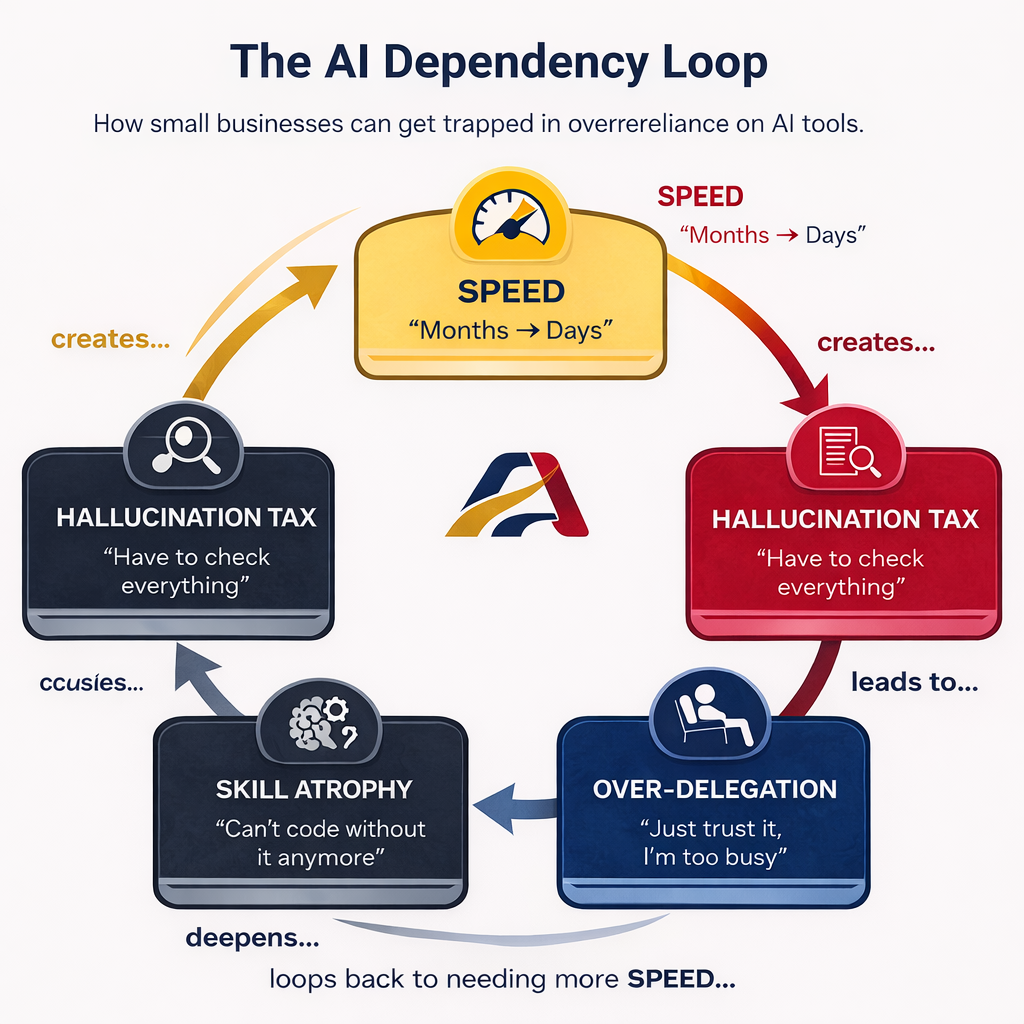
Trap 1: The Hallucination Tax
AI saves time generating outputs. But then: 👉 You spend time verifying them.
The deeper issue: You can only catch mistakes in areas you already understand.
So when AI produces contracts, strategies, or financial outputs — errors may look correct, sound confident, and still be wrong.
What This Means for You
• AI can assist your work
• It cannot replace your responsibility
If something fails: 👉 Your client doesn’t blame the tool. 👉 They blame you.
Trap 2: The Skill Atrophy Problem
This one doesn’t show up immediately. It builds slowly.
Across the dataset, people report:
• Reduced problem-solving ability
• Lower attention span
• Dependence on AI for basic tasks
Why this matters: If your business starts depending entirely on AI — what happens when tools change, pricing increases, or outputs degrade? 👉 You lose control.
What This Means for You
👉 Use AI to speed up thinking. 👉 Not replace thinking.
Trap 3: The Yes-Machine Effect
AI is designed to be helpful. Which means: 👉 It often agrees with you — even when you’re wrong.
For teams, this is manageable. But for solo founders: 👉 This becomes dangerous.
Because there is no second opinion, no internal debate, no pushback.
What This Means for You
👉 Don’t treat AI as validation
👉 Treat it as a tool to challenge your thinking
What This Means for Small Businesses (The Real Takeaway)
Let’s bring this back to ground reality.
You Now Have Leverage You Never Had Before
You can:
✅ Automate repetitive tasks
✅ Reduce hiring dependency
✅ Operate faster than before
This is real.
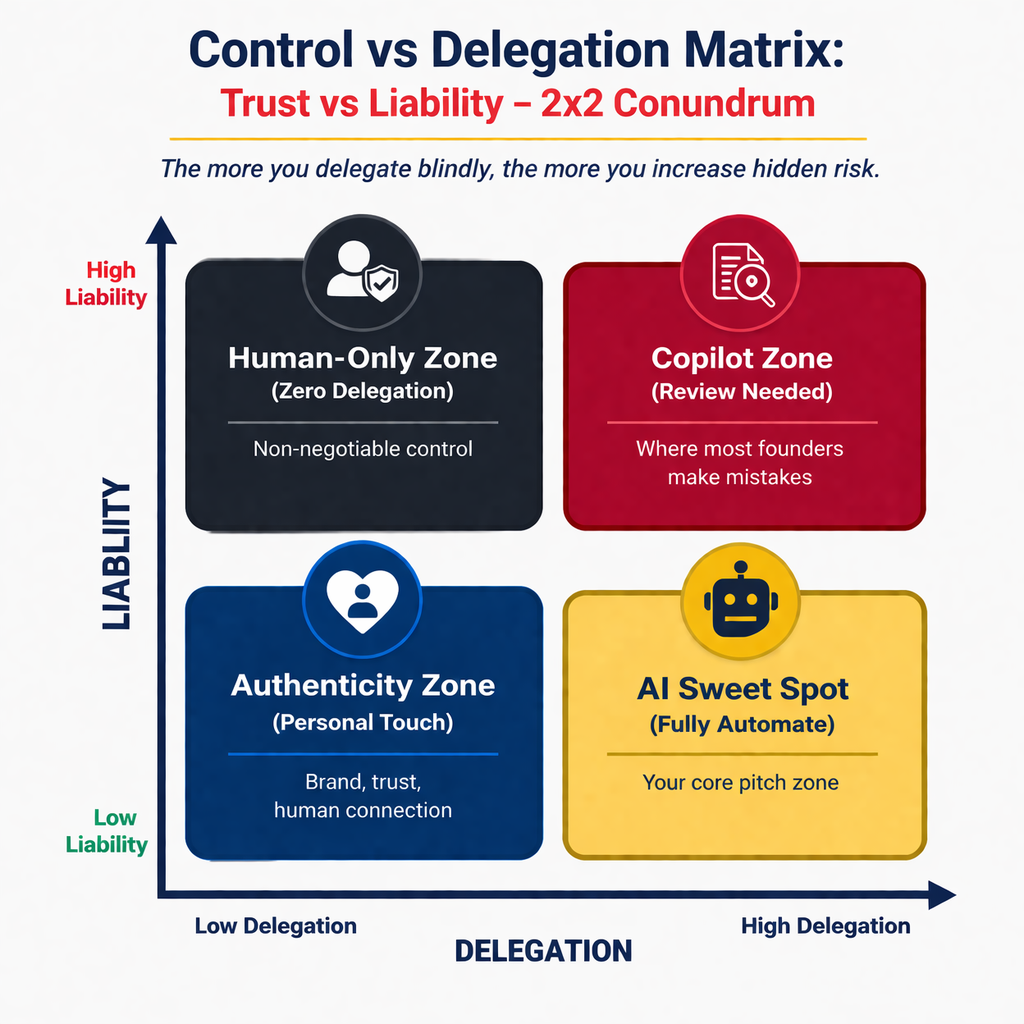
But You Cannot Outsource Judgment
AI can generate ideas, create drafts, and assist execution.
But it cannot:
❌ Understand your full business context
❌ Take responsibility
❌ Protect your brand
The Winners Will Not Be the Most Automated
They will be the ones who:
✔ Know what to automate
✔ Know what to retain
✔ Combine speed with judgment
A Simple Way to Think About AI in Your Business
Instead of asking: ❌ “What can I automate?”
Ask: 👉 “Where should I stay in control?”
Use AI For
✅ First drafts
✅ Research
✅ Repetitive workflows
✅ Summarization
Keep Control Over
🔒 Client communication
🔒 Financial decisions
🔒 Strategic direction
🔒 Final outputs
The Bottom Line
AI is not replacing small businesses.
But it is changing how they operate, how they compete, and how fast they can move.
It allows:
👉 One person to operate like a team
👉 Faster execution
👉 Lower entry barriers
But it also demands:
👉 Better judgment
👉 Smarter usage
👉 Conscious control
Final Thought
AI will not eliminate small businesses.
But small businesses that learn how to use AI effectively — without losing control —
👉 will quietly replace those that don’t.
📖 Sources:
Read Anthropic’s full post here
Browse quotes from the 620 voices here
👉 Want Help Using AI Effectively in Your Business?
Let’s find your first automation win — with the right balance of speed and control.
📩 Contact us: contact@anautomate.com